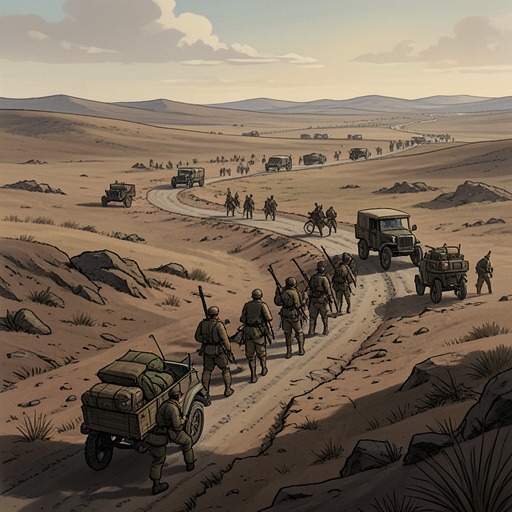
Wartime checkpoint passage protocol
Another Day of LifeThe Wartime checkpoint passage protocol is a practical code for moving through a fragmented wartime landscape, where a journey depends not only on the road but on the people who control each improvised barrier. It makes passage a sequence of cautious gestures and judgments: travelers must approach without provoking the sentries, establish who they are, and discover which armed group stands before them. A document may help secure cooperation, but it cannot remove the uncertainty built into the encounter.
Why passage requires a protocol
The narrator has repeatedly gone to the general staff to obtain a pass for the southern front. Without one, travel around the country is described as impossible: document inspections are posted on roads leading into and out of towns, while additional checkpoints may be raised by wary villagers or by nomads grazing herds far from settlements. The system is therefore not confined to a formal boundary or a single authority’s fixed stations. It reaches from town approaches into open country, where a traveler may meet a barrier without warning.
The pass answers a real need, but the protocol rests on more than paperwork. The expedition’s fate, and potentially the travelers’ lives, are in the hands of sentries whose allegiance and capacity are not immediately evident. A traveler has to learn local customs and show respect for them to proceed without hindrance and reach the destination safely. The procedure is a survival practice developed for a place where an official route does not guarantee orderly passage.
The sentries and their barriers
The people manning checkpoints come from varied backgrounds: rear-guard soldiers, local militia, young people drawn into the fervor of war, and children. Their equipment is similarly diverse, ranging from submachine guns and old carbines to machetes, knives, and clubs. Uniform is no more dependable as a guide. A sentry may wear a military blouse, but may instead appear in a bright shirt; a helmet is possible, but so is a woman’s hat; heavy boots give way to sneakers or bare feet. The account characterizes this as an impoverished war, visibly marked by the inexpensive clothing available to its participants.
The checkpoint itself may be assembled from gasoline drums, piles of stones, tree trunks, or even a wardrobe. These makeshift barriers, the varied dress, and the mixture of weapons make identification difficult. Near the front, the opposing armies can look alike, and large areas function as no-man’s-land into which first one side and then another moves to establish control. At the start of an encounter, travelers may not know who the sentries are or what they intend to do. The danger comes in part from this gap between seeing an armed group and understanding its allegiance.
The stages of an encounter
The protocol divides a checkpoint meeting into three parts: explanation, bargaining, and friendly conversation. Its first instructions concern approach. The vehicle should move slowly and stop at a respectful distance; abrupt braking or squealing tires is a poor opening. Travelers then leave the car and walk toward whatever serves as a barrier. Near a front line, fear can make this measured procedure difficult, but the account presents restraint as essential: a careless arrival can worsen an already uncertain situation.
The explanatory stage establishes the travelers’ identity and itinerary. They say who they are, where they are going, and where they have come from, and present the general staff pass at this point. That document typically describes the correspondent as a friend and reliable person of good will, then asks comrades at the front and in the rear to offer hospitality and assistance. It is a request for recognition and cooperation, not a guarantee of safe passage.
The pass can create a further obstacle if the sentry cannot read. The account describes this as a widespread problem among peasant and nomad sentries. Better-organized checkpoints sometimes employ children for this task, since children may have learned to read more often than adults in a country where schools have only recently begun to develop. Literacy thus becomes part of the practical machinery of passage: the document’s value depends on someone at the barrier being able to understand it.
Recognition, risk, and the limits of the pass
Before travelers can explain themselves, they must try to identify the group confronting them. If the sentries belong to Agostinho Neto’s forces, their comradeship greeting signals that the travelers are likely to live. If they belong to Holden Roberto’s or Jonas Savimbi’s forces, a different greeting is used, and a mistaken response can have fatal consequences. The account notes that established checkpoints have small cemeteries associated with people who greeted the sentries incorrectly. Recognition is therefore not a matter of political terminology alone: a single word can disclose whether a traveler has understood the danger at the barrier.
Correct recognition does not settle everything. The relief of realizing that the travelers may survive is brief, because whether they can continue their journey remains unresolved. The stages of explanation, bargaining, and conversation follow, with the pass offering a basis for asking assistance rather than overriding the sentries’ authority. The protocol manages uncertainty by giving travelers a cautious order of actions, but it cannot make the competing forces, improvised posts, or shifting territories predictable.
The rule’s significance lies in how it makes ordinary travel depend on performance as well as permission. A slow approach, a legible pass, accurate identification, and the correct greeting can matter more than the appearance of a formal road or uniformed authority. In this account, the checkpoint is both a physical obstruction and a brief encounter in which the traveler must read people, objects, and allegiance before moving onward. The protocol offers a way through that uncertainty, not an escape from it.